
On a Genting Dream cruise your money lives in two different worlds. Onboard, everything is cashless and billed in Singapore dollars. But the moment you step ashore in Penang, Phuket, Port Klang or Bali, you need local cash and cards that don't quietly charge you 3% every time you tap. Get this right and you'll spend at near-perfect exchange rates with almost no fees; get it wrong and the "small" currency markups add up to a wasted dinner's worth of money by the end of the trip. Here's the honest, practical guide to handling multiple currencies on a cruise — what to carry, which multi-currency cards actually save money, and the one setting that costs people the most.
This pairs naturally with our cruise credit-card guide (for the big fare payment and rewards) and the honest cost breakdown so you can budget every currency before you sail.
Why currency planning matters on a cruise
A regional cruise from Singapore is unusually multi-currency for such a short trip:
- Onboard: cashless, billed in SGD to your cruise card and settled to your credit/debit card at the end.
- Malaysia ports (Penang, Port Klang, Melaka): Malaysian Ringgit (MYR).
- Thailand ports (Phuket, Ko Samui): Thai Baht (THB).
- Indonesia ports (Bali, Lombok): Indonesian Rupiah (IDR) — plus a small local tourism tax paid in cash onboard/ashore.
Every time you convert between these with a normal bank card, you can lose 3–5% to foreign-exchange fees and poor rates. A multi-currency travel card cuts that to near zero.
The single most expensive mistake — "Dynamic Currency Conversion" (DCC): when a shop, restaurant or ATM abroad asks "pay in SGD or local currency?", always choose local currency. Choosing your home currency lets the merchant's bank set the rate — usually 3–5% worse. No card, however good, can protect you if you opt in. This one habit saves more than any card choice.
The three things to carry
The ideal cruise money setup is a simple combination, not a single product:
- A rewards credit card for the big fare and onboard account (earns miles/cashback — see our card guide).
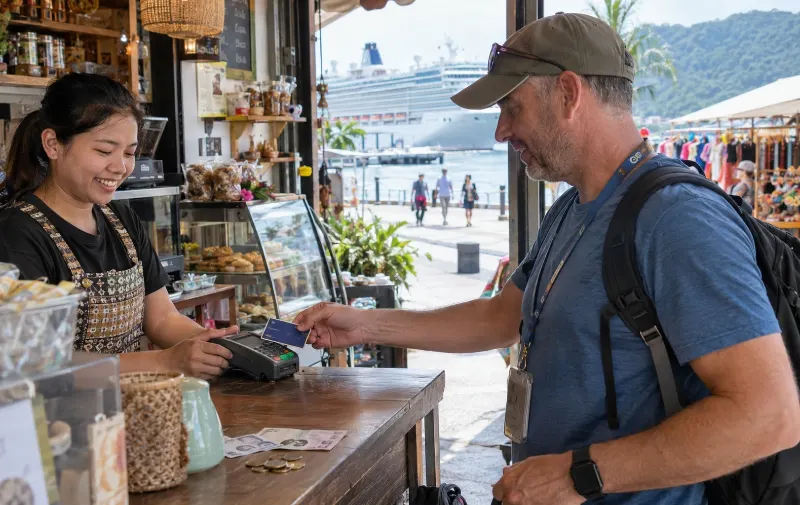
- A multi-currency / forex card for tap-and-go spending ashore at wholesale rates with 0% FX.
- A little local cash for small vendors, markets, taxis, temples and tips — many port stalls are cash-only.
Multi-currency cards, compared honestly (2026)
For Singapore-based cruisers these are the main options. They're e-money wallets, not bank accounts, so balances aren't SDIC-protected — keep only what you'll spend. Rates and fees change, so confirm current terms before you travel.
| Card | FX fee | Best for | Watch out for |
|---|---|---|---|
| YouTrip | 0% on 12 wallet currencies (incl. MYR, THB) | Simplest all-round travel card; ~S$400/mo free ATM | Prepaid — top up before you spend |
| Wise | Small visible ~0.23–0.45% fee | Holding 40+ currencies; overseas transfers (UPI to India, DuitNow to MY) | From May 2026 only ~S$100/mo free ATM; can't use at SG ATMs |
| Revolut (Standard) | 0% weekdays; 1% weekends (Standard) | Budgeting tools, virtual cards; higher ATM limits | Weekend markup + monthly fee-free cap on Standard |
| Trust Cashback (SG) | 0% FX + cashback | A credit card that doubles as a fee-free travel card | It's a credit card — pay in full |
The honest take from the comparisons: YouTrip is the easiest default travel card (no markup on its wallet currencies, decent free-ATM ceiling, no weekend surcharge). Wise wins for transfers and holding many currencies. Revolut suits budgeting fans who avoid weekend spends. Many people carry YouTrip for tapping + Wise for transfers. On a typical trip you'll save roughly S$40–60 per S$1,000 spent versus a plain bank card.
By country: what travellers from your market should do
Singapore
A multi-currency card (YouTrip/Revolut/Wise) plus a rewards credit card is the standard, near-optimal setup. Lock in MYR/THB in-app if you like certainty on the rate.
Malaysia
Multi-currency options include Wise, BigPay and bank travel wallets; for Thai/Indonesia ports these beat a plain Ringgit debit card's FX fee. DuitNow-linked transfers are handy for topping up.
India
Indian debit/credit cards carry a ~2–3.5% forex markup + GST abroad, so a dedicated forex/travel card (from banks like HDFC, ICICI, Axis, or fintechs) or a Wise account (top up via UPI) is usually cheaper for port spending. Carry some USD or local cash as backup, and note the RBI's TCS rules on large forex loads.
Australia & Indonesia
Australia: Wise and Revolut are widely used; several banks also offer no-FX travel accounts. Indonesia: use a multi-currency card where accepted and carry Rupiah cash for smaller vendors; confirm your card's markup before relying on it ashore.
How much local cash to actually carry
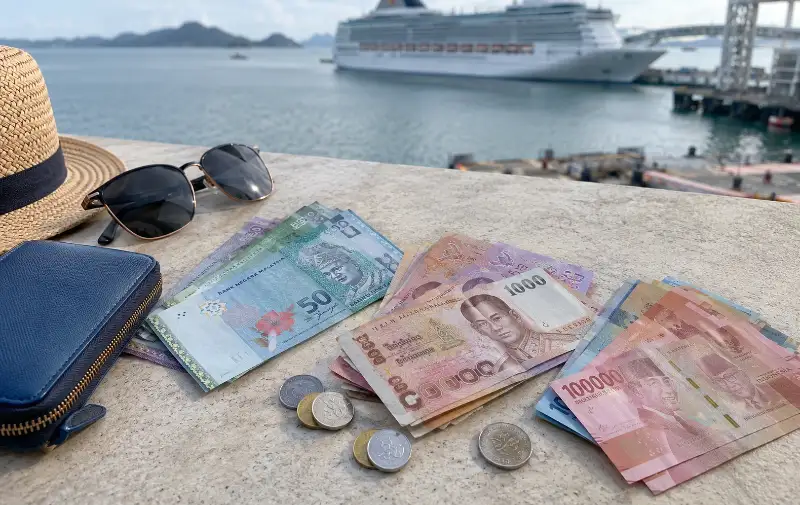
Cards are widely accepted in malls and bigger restaurants, but port-day life is cash-friendly. A rough guide per port day, per couple:
- Penang / Port Klang / Melaka: ~RM 150–300 for street food, taxis/Grab, entry fees and markets.
- Phuket / Ko Samui: ~THB 2,000–4,000 for tuk-tuks, beaches, food and small shops.
- Bali / Lombok: ~IDR 500,000–1,000,000 for taxis, temples, warungs and the tourism tax.
Withdraw from an ATM in port using your multi-currency card (mind the monthly free-withdrawal cap) rather than changing cash onboard, where rates are poor. Don't over-withdraw — leftover exotic cash is hard to use up.
Onboard tip: the ship's exchange desk and the "pay in your home currency" option both give weak rates. Treat onboard forex as an emergency only. Sort your cards and a little starter cash before you sail, when you can shop around for the best rate at home.
Avoiding fees: the quick checklist
- Always pay in local currency — decline DCC every time.
- Use a 0% (or near-0%) FX multi-currency card for ashore spend.
- Withdraw cash within your card's free-ATM limit; avoid airport and onboard exchange counters.
- Carry a modest amount of each local currency for cash-only vendors.
- Don't convert onboard unless it's a genuine emergency.
- Tell your bank you're travelling so cards aren't blocked at the first foreign tap.
- Keep a backup card separate from your wallet in case of loss.
The bottom line
A cruise packs several currencies into a few days, which is exactly where small percentages become real money. The winning setup is simple: a rewards credit card for the big fare, a 0% FX multi-currency card for tapping ashore, and a little local cash for markets and taxis — and, above all, always pay in the local currency and never accept "conversion to SGD". Do that and your money goes further in every port, leaving more for the fun stuff.
Planning which ports you'll actually visit? See how much time you get ashore in our itinerary guide, and tell us your dates for a live quote and honest advice — usually within the hour. Next read: our cruise travel-insurance guide.
This article is general information, not financial advice. Card fees, exchange rates, ATM limits and regulations vary by provider and country and change frequently. Always confirm current terms with the provider before travelling.
More from the blog
View all → Cabins & Suites
Genting Dream Palace Suite Review — Is Ship-Within-a-Ship Worth It?
5 Oct 2026 · 12 min read
Cabins & Suites
Genting Dream Palace Suite Review — Is Ship-Within-a-Ship Worth It?
5 Oct 2026 · 12 min read
 Cruise Tips
Genting Dream Entertainment & Shows Guide (Zodiac Theatre, Zouk)
2 Oct 2026 · 12 min read
Cruise Tips
Genting Dream Entertainment & Shows Guide (Zodiac Theatre, Zouk)
2 Oct 2026 · 12 min read
 Cruise Tips
Genting Dream Casino Guide: Games, Rules & Tips
30 Sep 2026 · 9 min read
Cruise Tips
Genting Dream Casino Guide: Games, Rules & Tips
30 Sep 2026 · 9 min read
 Cruise Tips
Best Time to Book a Genting Dream Cruise (Cheapest Months & Deals)
27 Sep 2026 · 10 min read
Cruise Tips
Best Time to Book a Genting Dream Cruise (Cheapest Months & Deals)
27 Sep 2026 · 10 min read
 Cruise Tips
Genting Dream with Kids: The Honest Family Cruise Guide
23 Sep 2026 · 12 min read
Cruise Tips
Genting Dream with Kids: The Honest Family Cruise Guide
23 Sep 2026 · 12 min read
 Cruise Tips
Shore Excursions Guide: Penang, Phuket & Melaka
12 Sep 2026 · 11 min read
Cruise Tips
Shore Excursions Guide: Penang, Phuket & Melaka
12 Sep 2026 · 11 min read
Ready to book your Genting Dream cruise?
Tell us your dates and cabin preference — we'll send a live quote, usually within the hour.
← Back to all guides