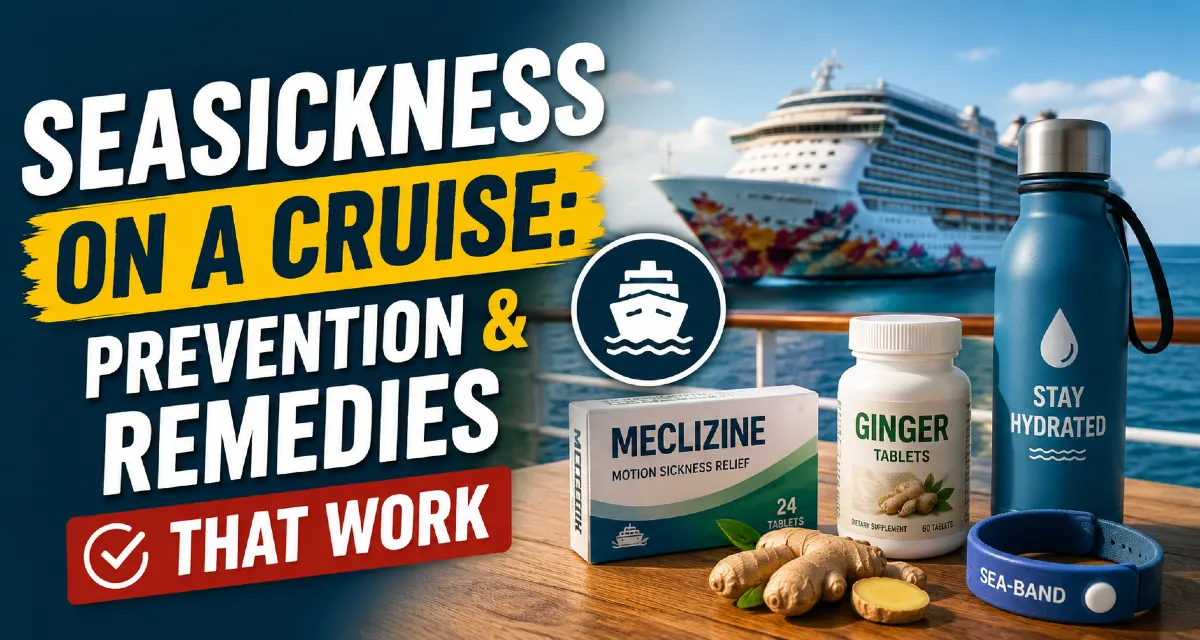
Here's the reassuring part first: most people on the Genting Dream never feel seasick at all. It's a large, stabilised ship, and the short Singapore–Malaysia sailings stay in calm, sheltered coastal water. But "most people" isn't "everyone" — seasickness affects a meaningful share of cruisers at some point, and the ones who suffer usually make the same avoidable mistake: they wait until they already feel awful before doing anything. This guide is the opposite approach — what actually works, when to use it, and how to match the remedy to how prone you are. It's based on medical guidance and real cruiser experience, not old wives' tales.
Quick note before we start: this is general information, not medical advice. If you have a health condition, are pregnant, or take other medication, check with a pharmacist or doctor before using any seasickness medicine — some of the options below aren't suitable for everyone.
Why seasickness happens (and why it matters here)
Seasickness is not weakness or a disorder — it's a normal response to conflicting signals. Your inner ear feels the ship moving, but your eyes (looking at a stationary cabin wall) tell your brain you're still. That sensory mismatch triggers nausea, cold sweats, headache and fatigue. Understanding this is useful, because every good remedy either calms the inner-ear signal (medication) or reduces the mismatch (looking at the horizon, fresh air).
The good news for Genting Dream guests: the ship's size and modern stabilisers, plus the calm coastal routes, mean motion is usually mild. The rougher, more open-sea stretches tend to be on the longer Phuket, Ko Samui and Bali sailings rather than the 2-night Cruise to Nowhere or Malaysia runs.
The single most important rule: act before symptoms start
If you take one thing from this page, take this. Every seasickness medication works far better as prevention than as a cure. Once nausea has kicked in, tablets are fighting a losing battle — and if you're already vomiting, you can't keep a pill down anyway. Clinicians are unanimous on this: timing is where prevention is won or lost. Dose before sail-away, not after the ship starts to move.
The classic mistake: "I'll wait and see if I feel sick first." By then it's too late for most remedies to work properly, and you can lose a day or more of your cruise recovering. If you have any history of motion sickness, treat it as prevention from the start.
Match the remedy to how prone you are
You don't need everything — you need the right level. Here's the honest, tiered approach that travel-health clinicians actually recommend.
If you've never been seasick (mild / just cautious)
Start light and drug-free. These have no side effects and are easy to escalate if needed:
- Acupressure wristbands (e.g. Sea-Band) — a plastic bead presses a point on your inner wrist. The clinical evidence is mixed — some swear by them, others feel nothing — but they're cheap, reusable, drug-free and come in child sizes, so they're a sensible first line.
- Ginger — chews, capsules, tea or crystallised ginger. Evidence for motion sickness specifically is inconsistent, so treat it as a comfort aid for mild queasiness rather than your main defence.
If you sometimes get carsick / travel sick (moderate)
Add a proven over-the-counter antihistamine to the wristbands:
- Meclizine (sold as Bonine and other brands) — the cruise favourite because it's less drowsy than the alternative. Typically taken about 1–2 hours before boarding, then once every 24 hours. Effects last around a day.
- Dimenhydrinate (Dramamine) — also effective but more sedating. Usually taken 30–60 minutes before sailing, repeated every 4–6 hours as needed. Good as a "rescue" during a rough patch, but expect drowsiness.
If you know you get seasick, or seas may be rough (strong)
This is where the scopolamine patch (brand name Transderm Scop / Scopoderm) comes in — widely considered the most effective single option for multi-day trips:
- It's a small patch worn behind the ear that releases medication steadily through the skin for up to 72 hours — a genuine "set it and forget it" option.
- Apply it the night before, or at least 4–8 hours before boarding, so it's working before you sail.
- It's prescription-only in most countries, so see your doctor a couple of weeks before the cruise, not the day before.
- Possible side effects include dry mouth, blurred vision and drowsiness. Wash your hands thoroughly after applying (the medication mustn't get into your eyes).
Important safety point: do not combine a scopolamine patch with antihistamines like dimenhydrinate without a doctor's guidance — stacking these drugs increases side effects like severe drowsiness, confusion and dry mouth. People with glaucoma, urinary-retention issues or certain conditions shouldn't use scopolamine at all. Always test any new remedy on land first so you know how your body reacts.
The free things that genuinely help
Medication is only half the picture. These cost nothing and work by reducing the sensory mismatch — use them alongside whatever remedy you've chosen:
- Look at the horizon. Get on deck and fix your eyes on the distant, stable line where sea meets sky. It re-syncs what your eyes and inner ear are telling your brain.
- Get fresh air. Stuffy indoor spaces make it worse; a breezy open deck makes it better.
- Face forward, don't read. Reading, phones and screens during motion intensify the mismatch. If you must look at something, keep it at a distance.
- Eat light and bland. Plain crackers, toast, pretzels, green apple. An empty stomach and a heavy, greasy meal are both bad ideas — a little bland food settles things.
- Stay hydrated, and go easy on alcohol, which worsens both dehydration and dizziness.
- Rest and lie down if a wave of nausea hits — lying still with your eyes closed reduces the conflicting signals.
Your cabin choice matters more than you'd think
Where you sleep on the ship affects how much motion you feel. The physics is simple — think of a seesaw: the middle barely moves while the ends swing most.
- Book a mid-ship cabin on a lower-to-middle deck if you're motion-sensitive. This is the most stable part of any ship — it pitches and rolls the least.
- Forward (front) and very high cabins feel the most movement in rough water.
- If you can, an ocean-view or balcony cabin helps too — being able to see the horizon from your room settles the senses faster than staring at an interior wall.
We break down every cabin category and exactly where each sits in our cabin guide and deck plan — worth a look before you book if seasickness is a real worry for you.
Choosing a gentler itinerary
If you're genuinely anxious about motion, you can stack the odds in your favour with the route itself. The 2-night Cruise to Nowhere and the Melaka / Port Klang sailings stay in calm, sheltered coastal water and are the gentlest introduction. The longer open-sea legs to Phuket, Ko Samui and Bali have more movement — still usually mild on a ship this size, but worth knowing. See how much sea time each route has in our itinerary guide.
On board: what the Genting Dream offers
You don't have to bring everything yourself. The ship's medical centre and reception can help if you're struggling, and basic seasickness tablets are typically available onboard — though they cost more than bringing your own, and the brand may differ from what you're used to. Our advice: pack your preferred remedy from home so you're not relying on availability, but know that help is there if a rough patch catches you out.
Seasickness or something else? Don't confuse the two
One genuinely important distinction. If your nausea and vomiting last more than a day, come with fever or diarrhoea, or wristbands and fresh air do nothing, it may not be seasickness at all — it could be a stomach bug like norovirus, which spreads on any cruise ship and lasts 48–72 hours. Seasickness eases when the sea calms or you're on deck; a virus doesn't. The best defence against the latter is frequent, thorough hand-washing and hand sanitiser, especially before eating at the buffet. If symptoms are severe or persistent, see the ship's medical centre.
Your simple pre-cruise plan
- Be honest about how prone you are and pick your tier: wristbands/ginger (mild), + meclizine (moderate), + scopolamine patch (strong).
- If you want the patch, see your doctor 1–2 weeks ahead — it's prescription-only.
- Test any new medication on land first to check how it affects you.
- Book a mid-ship, lower-deck cabin if motion is a real concern.
- Dose before sail-away — prevention, not cure.
- On board: horizon, fresh air, light food, hydration; lie down if it hits.
Do that and the odds are strongly in your favour — most Genting Dream guests spend the whole cruise feeling completely fine. For the full run-down of everything else to pack, see our Genting Dream packing list, and when you're ready to choose a sailing and the right cabin, tell us your plans — we'll send honest advice and a live quote, usually within the hour.
This article is for general information only and isn't a substitute for professional medical advice. Consult a pharmacist or doctor before taking any medication, especially if you're pregnant, have a medical condition, or are giving medicine to children.
More from the blog
View all → Cruise Tips
Genting Dream with Kids: The Honest Family Cruise Guide
23 Sep 2026 · 12 min read
Cruise Tips
Genting Dream with Kids: The Honest Family Cruise Guide
23 Sep 2026 · 12 min read
 Cruise Tips
Shore Excursions Guide: Penang, Phuket & Melaka
12 Sep 2026 · 11 min read
Cruise Tips
Shore Excursions Guide: Penang, Phuket & Melaka
12 Sep 2026 · 11 min read
 Cruise Tips
Multi-Currency & Forex for a Cruise: Cards, Cash & Fees
10 Sep 2026 · 10 min read
Cruise Tips
Multi-Currency & Forex for a Cruise: Cards, Cash & Fees
10 Sep 2026 · 10 min read
 Cruise Tips
Best Travel Credit Card for a Cruise (Miles, Cashback & FX Fees)
7 Sep 2026 · 10 min read
Cruise Tips
Best Travel Credit Card for a Cruise (Miles, Cashback & FX Fees)
7 Sep 2026 · 10 min read
 Cruise Tips
Cheapest Way to Book Genting Dream (Klook vs Direct vs Agent)
31 Aug 2026 · 11 min read
Cruise Tips
Cheapest Way to Book Genting Dream (Klook vs Direct vs Agent)
31 Aug 2026 · 11 min read
 Cruise Tips
Do You Need Travel Insurance for a Cruise from Singapore?
28 Aug 2026 · 11 min read
Cruise Tips
Do You Need Travel Insurance for a Cruise from Singapore?
28 Aug 2026 · 11 min read
Ready to book your Genting Dream cruise?
Tell us your dates and cabin preference — we'll send a live quote, usually within the hour.
← Back to all guides